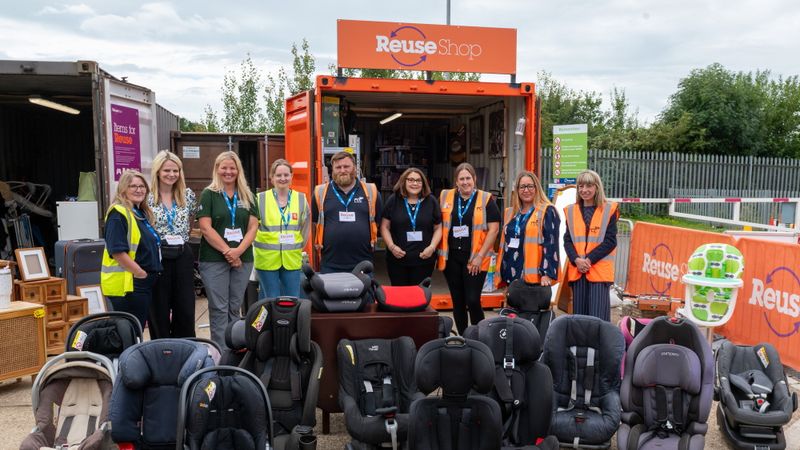
It offers residents the opportunity to donate their no longer needed car seats to a charity which works with families who don’t have access to the lifesaving equipment.
Kent County Council (KCC) is working with FCC Environment, which manages 14 Household Waste and Recycling Centres on its behalf, to launch the scheme in partnership with international charity EASST (Eastern Alliance for Safe and Sustainable Transport). The charity, which is based in Kent, works to improve road safety, sustainable transport, and environmental standards in 14 countries across Eastern Europe and Central Asia.
Each collected car seat undergoes a rigorous safety checklist, devised with the support of the AA, to ensure it is fit for reuse, preventing unsafe items from re-entering circulation while ensuring the safety for redistribution.
Correctly used child car seats can reduce the risk of being killed or seriously injured in a crash by up to 60% but in many countries, children still go without due to high costs and affordability. The donations will help children around the world and bring peace of mind to families.
The first collection took place on July 30, 2025, where 20 car seats were collected. These car seats are earmarked to be sent to Ukraine or to Ukrainian refugees living in Moldova where they will be matched with families who otherwise wouldn’t have the means to buy their own.
“We’re proud to be part of this inspiring initiative, supporting EASST in their mission to improve road safety and sustainability. ”
David Wimble, KCC’s Cabinet Member for the Kent Environment, said: "We’re proud to be part of this inspiring initiative, supporting EASST in their mission to improve road safety and sustainability.
“At the heart of Kent’s reuse programme is a commitment to empowering charities, communities, and meaningful causes — and this project takes that one step further.
“It’s a powerful reminder that small, local actions can spark global change: protecting children, supporting families, and giving new life to items once destined for disposal."
Vikki Sedgwick, FCC’s Education and communication officer said: "This project is about more than just reusing — it’s about protecting children on the roads and protecting our planet.
"Partnering with EASST allows us to reuse car seats which were destined for disposal and will now help someone in need. This project has been months in planning, so I am thrilled we have now made our first donation and look forward to many more.
Emily Carr, Deputy Director of EASST, said: “We are so grateful to be partnering with FCC Environment and KCC to deliver this programme. In the countries where we work, child road deaths are up to five times higher than in the UK.
“Ukraine and Moldova are the poorest countries in Europe so by collecting car seats that are no longer needed here we can truly make a difference, and we couldn’t be more thankful to the UK families who have donated.”
EASST, which works across Eastern Europe and Central Asia to promote safe and sustainable transport, brings extensive expertise to the programme, ensuring all items are processed with both safety and sustainability in mind. Plans are underway to assess the success of the New Romney collections and explore expansion to other HWRCs in Kent.
EAAST will come and collect the car seats but will only take them if they have the safety booklet or the safety instructions printed/stickered on the seat itself.
Any car seats that are not used by EAAST will either be recycled at sites with hard plastic segregation, or sent with bulky waste which goes for what’s called Refuse Derived Fuel – where the waste is shredded and burnt to produce energy.